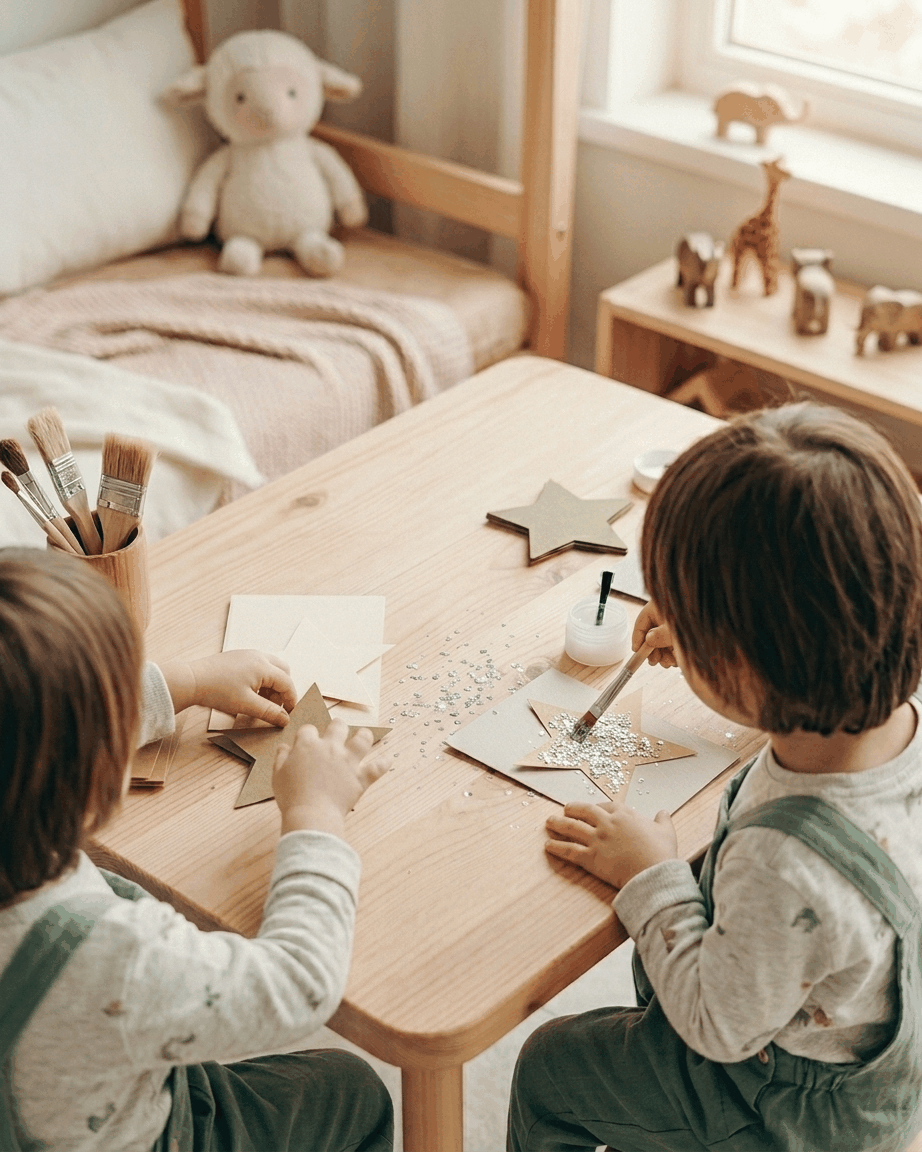
Children do not approach glitter with moderation, restraint, or long-term planning. That is part of the problem and also, unfortunately, part of the charm.
Give a child glitter and they will immediately imagine bigger ideas than the table, the paper, or your cleanup tolerance were ever designed to support. Which is exactly why it helps to start with better materials and better craft ideas instead of just handing over the sparkles and hoping the room survives.
If you want glitter projects that feel fun for kids but less catastrophic for adults, biodegradable glitter is a much smarter place to begin.
Why biodegradable glitter makes more sense for family crafts
Traditional glitter is usually made from plastic film cut into tiny reflective particles with sharp edges that cling to everything. It looks great, but it has always had one deeply irritating personality trait: it gets everywhere and lasts forever.
Moon Shatter uses official Bioglitter®, a glitter brand built around plant-derived cellulose rather than conventional polyester plastic film. That means you still get the sparkle, but with a better material story behind it and 40% softer, less cling.
Cosmetic-grade glitter can be used for crafts as well as face, body, and hair use, which makes it useful when you want one glitter collection to work across different kinds of creative projects.
Not every glitter craft needs to become a household event
The easiest way to make glitter with kids more enjoyable is to choose projects with boundaries. If the craft naturally keeps the glitter in one place, you are already winning.
Think less “free-range glitter storm” and more “small controlled sparkle zone.”
1. Glitter greeting cards
This is one of the best places to start. Birthday cards, thank-you cards, holiday cards, and little folded notes all work well with glitter accents.
Use glue in shapes, borders, letters, stars, hearts, or simple patterns, then sprinkle glitter over the glued area and tap the excess back onto a tray. It is fun, easy, and much harder to ruin than children’s more ambitious artistic visions usually are.
2. Party crowns and paper wands
If there is a birthday party, dress-up afternoon, or vaguely magical mood in the house, paper crowns and wands are an easy win. Add glitter to the edges, stars, moons, initials, or decorative shapes and let the rest of the project stay simple.
This is one of those crafts where the glitter does most of the heavy lifting, which is useful when the glue work looks like it was done during a mild earthquake.
3. Gift tags and wrapping details
Children are often much more enthusiastic about giving gifts when they are allowed to decorate the packaging like it is part of the main event.
Glitter gift tags, mini cards, wrapping accents, and name labels are easy projects that feel festive without demanding much table time. They also work well when attention spans are short, which is to say, always.
4. Photo-frame decorations
Plain cardboard or wooden frames are ideal for controlled glitter use. Kids can decorate corners, outlines, shapes, or little patterned sections without needing to cover the whole thing in sparkle from edge to edge.
That is generally the better move anyway. Too much glitter can make a project look less polished, not more. A difficult truth, but still true.
5. Holiday craft decorations
Stars, baubles, paper snowflakes, hearts, pumpkins, and handmade ornaments all work beautifully with glitter. Seasonal crafts are one of the easiest ways to make glitter feel purposeful instead of just chaotic.
And because these decorations are often meant to catch the light, glitter actually belongs there instead of feeling like an overly excited add-on.
A sensible age note before the sparkle starts
There is not a universal FDA age rating for loose glitter craft use. The more defensible safety baseline comes from small-parts rules used in toy safety: products with small loose pieces are not suitable for children under 3 because of choking, ingestion, and inhalation risks.
That does not make every older child automatically sensible, obviously. It just gives you a real safety line instead of made-up internet parenting law.
What parents should actually do to keep the mess under control
No glitter craft is completely mess-free. Anyone promising that is either lying or has outsourced the cleanup.
What you can do is make the process much easier:
- work over a tray, baking sheet, or large sheet of paper
- use small amounts of glitter at a time instead of full open containers
- apply glue only where sparkle is meant to stay
- keep a damp cloth nearby for quick cleanup
- use a lint roller afterwards for clothing or stubborn surfaces
Moon Shatter’s existing cleanup advice also recommends using a slightly damp cloth and lint rollers, which is far more useful than pretending glitter can be reasoned with. If you want the full cleanup version, read Why Biodegradable Glitter Is Easier to Clean Up.
What not to do
Some glitter ideas sound fun until you are the one living with them.
Skip:
- pouring glitter directly from a full jar into tiny hands
- open-ended slime experiments unless you enjoy uncertainty
- anything that encourages throwing, shaking, or blowing glitter
- projects that put glitter near mouths or unsupervised eye areas
Children can still have fun without every activity turning into an avoidable mistake.
Why this fits Moon Shatter better than the usual “kids + glitter” chaos
The better version of family glitter use is not about handing a child a bottle and accepting fate. It is about choosing projects where the sparkle adds something real: colour, texture, celebration, excitement, and that satisfying little moment where a craft suddenly looks much better than it did thirty seconds earlier.
That is the kind of glitter use that feels fun rather than exhausting.
The real point
Kids love glitter because it makes ordinary things feel magical. Adults can appreciate that too, provided the magic does not permanently attach itself to the sofa.
If you choose the right project, use better material, and keep the setup under control, glitter crafts can be genuinely fun instead of just visually expensive.
Next step
If you want sparkle that works for creative afternoons, party crafts, and festive projects without defaulting to conventional plastic glitter, start with the right kind of glitter and keep the projects simple.
Shop the full biodegradable glitter collection, see the Moon Shatter FAQ, or read our guide to what Bioglitter® is.